
What is punctuation? Learn how punctuation marks structure sentences, clarify meaning, and help you communicate clearly in your writing.
Previously, we featured a popular series for beginner writers: All About Parts Of Speech. Now, we’re starting a series called Punctuation For Beginners.
I am beginning with:
What Is Punctuation?
‘Punctuation marks are the traffic signals of language: they tell us to slow down, notice this, take a detour, and stop.’ ~Lynne Truss, Eats, Shoots & Leaves: The Zero Tolerance Approach to Punctuation

Punctuation is the name for the marks we use in writing. Punctuation marks are tools that have set functions. We use them to structure and organise our words, and to give sentences meaning and rhythm.
Punctuation marks help readers to understand what the writer is trying to say.
Without proper punctuation, serious sentences become jokes, misunderstandings flourish, and confusion reigns. For example, ‘Let’s eat, children.’ is very different to ‘Let’s eat children.’
Punctuation For Beginners
Please click on each one of these to find out more about them.
These are the most common punctuation marks:
- The Full Stop
- The Comma
- The Question Mark
- The Exclamation Mark
- The Semicolon
- The Colon
- The Hyphen
- The Em Dash
- The Bracket or Parenthesis
- The Inverted Comma/Quotation Mark
- The Ellipsis
- The Bullet Point
- The Apostrophe
Why Do We Need Punctuation?
Our motto at Writers Write is ‘Write to communicate.’ Knowing how and when to use basic punctuation marks allows you to write clearly. If you use them well enough, it will be impossible to misunderstand what you are trying to say. Your sentences will be more user-friendly.
‘When speaking aloud, you punctuate constantly — with body language. Your listener hears commas, dashes, question marks, exclamation points, quotation marks as you shout, whisper, pause, wave your arms, roll your eyes, wrinkle your brow. In writing, punctuation plays the role of body language. It helps readers hear the way you want to be heard.’ ~Russell Baker
Is Punctuation The Same Everywhere?
The use of punctuation marks has changed over time. There are fewer punctuation marks in modern writing than there were in the past.
It also depends on where you use it. This sometimes changes according to the country in which you live, the organisation for which you write, or the company for which you work.
Many universities, newspapers, and companies create a style guide. This guide is a set of rules that promotes consistency within the organisation. Punctuation marks are included in this guide.
We use British English at Writers Write. The important thing is to be consistent.
Suggested reading: What Is A Style Guide And Why Do I Need One? and 10 Things You Should Not Exclude From Your Style Guide
British vs American English
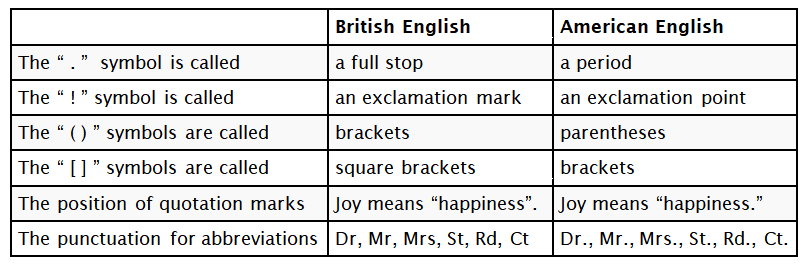
There are a few differences between punctuation in British and American English. The following chart details some of those differences:
The Last Word
- Punctuation helps us organise our words, clarify meaning, and communicate with our readers. Once you understand the basics, your writing becomes clearer and easier to read. Learn the rules, use them consistently, and let your punctuation help your words say exactly what you mean.
Next time, I will write about The Full Stop.
Resources for writers:
- The Complete Grammar Workbook
- Grammar For Beginners: All About Parts Of Speech
- The Ultimate Grammar Cheat Sheet for Writers (Infographic)

by Amanda Patterson
© Amanda Patterson
More posts from Amanda:
- What Is A Plot Twist? The Secret To Writing A Great One
- How To Write A Great Book Review
- How To Create Larger-Than-Life Characters
- Literary Book Title Generator | Find Your Novel’s Title
- Why Paying Attention Makes You A Better Writer
- What Is Mood? 140 Words To Describe Mood In Fiction
- What Is Fantasy Fiction? Plus A Fantasy Book Title Generator
- 9 Essential Character Questionnaires Every Writer Needs
Top Tip: Sign up for our free daily writing links.